Showing posts with label sewing machine. Show all posts

Saturday, July 31, 2010

In Case You Were Wondering

This is how you fit ten sewing machines in a 10'x12' room:

On top of the bookcase.

On every level surface, under the desk, and inside the cabinet.

And lined up along the wall with the extension tables removed to conserve space.

Oh, and I did say ten. I know last week it was nine, but this week it is ten. This is number ten:

She's a 1955 Singer 201, often called the finest machine Singer ever made. I can't attest to that, since I haven't tried every--or even most--machines Singer ever made, but she is a beauty. She has a "potted motor", which means that she is gear-driven. No belt to stretch or wear out and she's very quiet. Not nearly as powerful as my Pfaffs, but definitely an elegant lady. Once again (sorry, Kat!) $25 on craigslist, with the art deco cabinet. Yes, I am aware that I am approaching crazy cat lady territory with the sewing machines, but when they fall into my lap for less than the cost of a skein of sock yarn, what's a sewing machine enthusiast to do?

Sunday, July 18, 2010

What I've Been Doing...

...instead of knitting.

Yes, I'm afraid the obsession continues. This is my "new" Pfaff 230 from the 1950s. It is the forerunner of my Pfaff 360 from 1962, which I've shown here before. Here they are together:

They are very similar machines. They have almost all the same functions, except that the 230 is a flat bed machine, while the 360 has a free arm. The 230 has a more powerful motor and can run much faster. It sews beautifully, now that I've fully cleaned and oiled it, taken apart and cleaned the motor, and bought a new foot pedal and cords for it. I got this one for $25 off craigslist, complete with cabinet, accessories, and all sorts of sewing bits.

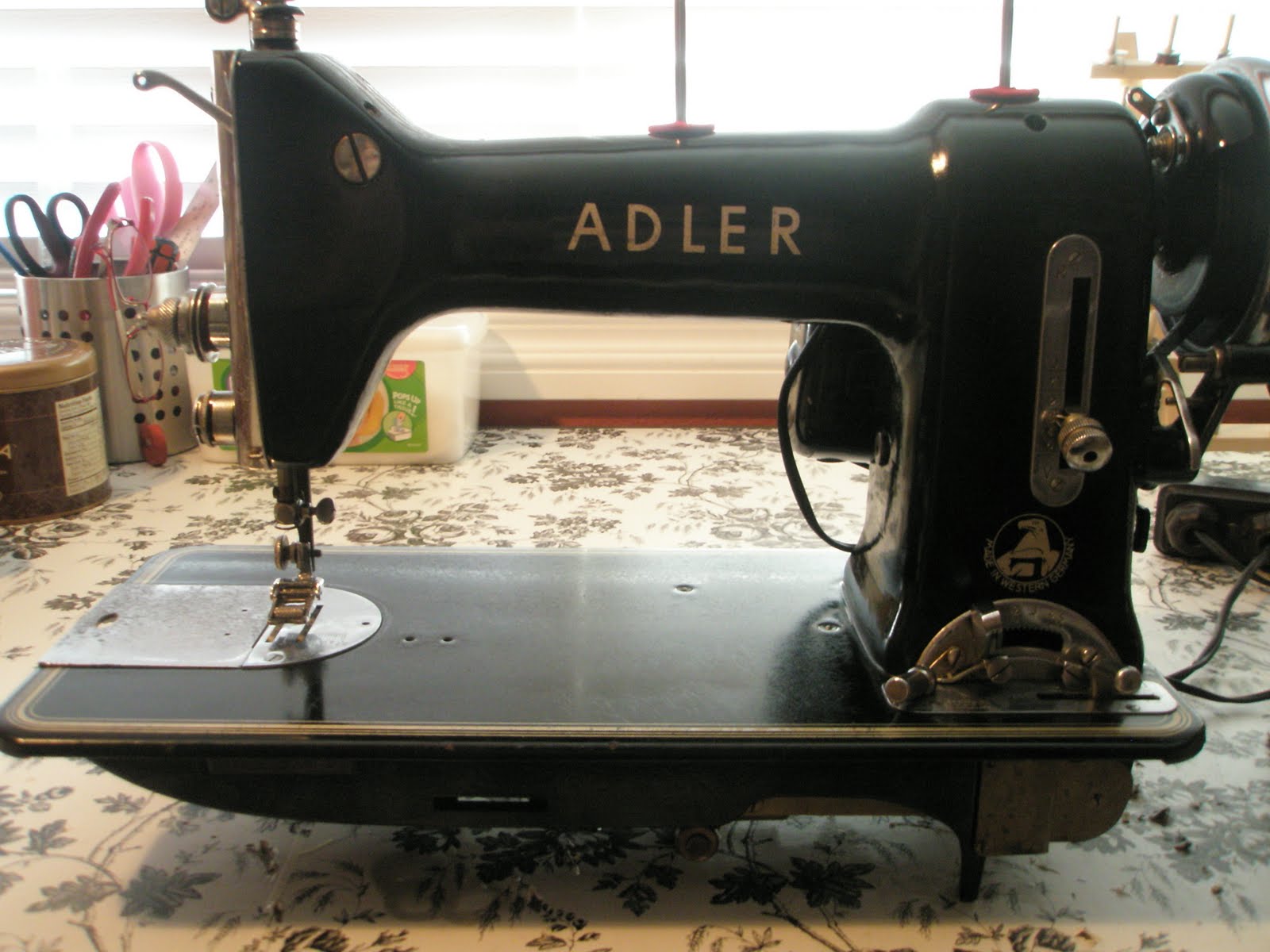
And this is another recent find--also $25 on craigslist. It is an Adler 187, which is another German machine, this one from somewhere between 1950 and 1952, which is the only time these machines were ever made. Apparently, Adler then switched to making only industrial machines. There are very few of these around. I have found exactly one online. I have read several opinions about these machines, though, claiming that they are even superior to the older Pfaffs that I love so much. Time will tell, I suppose.

This machine was in pretty rough shape. It had been stored in a damp shed for several years. It was in a cabinet that was cool-looking but very rickety--so rickety that when I tried to get it out of my car, it crumbled into a dozen pieces! Fortunately, I had the presence of mind to hang onto the piece holding the sewing machine. Dropping it would have been bad for both my foot and the machine. Once I extricated the machines from the remains of the cabinet, I carried it up to my workroom and started cleaning.

Every shiny metal bit was caked with rust. It was so bad that I bypassed my usual cleaning methods and sprayed the metal pieces with Lime Away. It worked like a charm. The rust just melted away. Here is a picture of the worst of the three bobbins before:

And after:


Unfortunately, the metal was pitted underneath the rust, and there's nothing I can do about that. I just wiped it with a little sewing machine oil and polished it up.

This is the only machine I have with the tensioning unit on the faceplate. I don't have a manual yet (and have been unsuccessful in locating one so far), so I'm not sure how to thread it.

If you look really closely, you can see that the labels on the feed dog lever (at the bottom in this pic), are in German: "nahen"--sew--for up, and "stopfen"--darn--for down. I love that.

Not sure whether I should admit this, actually, but these two bring the total number of sewing machines in my workroom to nine.

Maybe I should sew something.

Sunday, July 11, 2010

Tour de...

...Treadling?

I am not a fan of spectator sports. Although I grew up playing sports (I lettered in five sports in high school and continued to play through college and grad school), I've never liked sitting around watching other people play. I am especially baffled by the concept of "professional sports", which to me seems a complete oxymoron. Sort of like "professional sleeping" or "professional reading". So I am only peripherally aware of major sporting events, and almost always because of their connection to knitting (the Knitting Olympics, the WIP Cup, and the Tour de Fleece come to mind). And so I am aware that the Tour de France is happening...somewhere. I am not participating in the Tour de Fleece, because my fondness for spinning doesn't quite extend to turning it into an endurance event. But there is pedaling--or, rather, treadling--happening around here anyway.

This is the beginning of Eliza's Quilt:

For those of you who may not have been around when this whole sewing machine obsession sprang full-grown into being a few months back, this is Eliza:

She is a 1922 Singer 66 "Redeye" treadle sewing machine (named Eliza after her birthplace of Elizabeth, New Jersey). After I purchased her (for the princely sum of $81), I carefully cleaned and polished the cabinet and cleaned, oiled, and adjusted the machine and treadle. And then I promptly leapt into sewing with my electric machines. But I've always wanted to learn to use her properly, and in the back of my mind I had this idea of an entirely treadle-made quilt.

Since my first quilt was so happily received and is so well used, another easy charm quilt for the sofa seemed appropriate. And when I found some charm packs on clearance for 60% off--in colors that match my family room, no less--I decided fate was telling me in no uncertain terms what I should attempt for my next sewing project. So, of course, I did.

It is oddly--oddly to me, at least--no more difficult than sewing with an electric machine. There is a learning curve with the treadle. Just like with a spinning wheel, you have to keep the wheel going the right direction. If you let it roll backward, you get a huge, tangled mess of thread that jams the needle and you have to stop, cut it loose, rethread the needle, pick out the seam, and start over. (Please don't ask me how I know. The less said the better. All ninety-three times.) But once the treadling aspect is mastered, it's very, very simple. Eliza is a straight stitch machine. She sews only in a straight line in one direction. No zigzag, no reverse. There's a certain minimalist satisfaction in that. She does only one thing, and she does it very, very well:

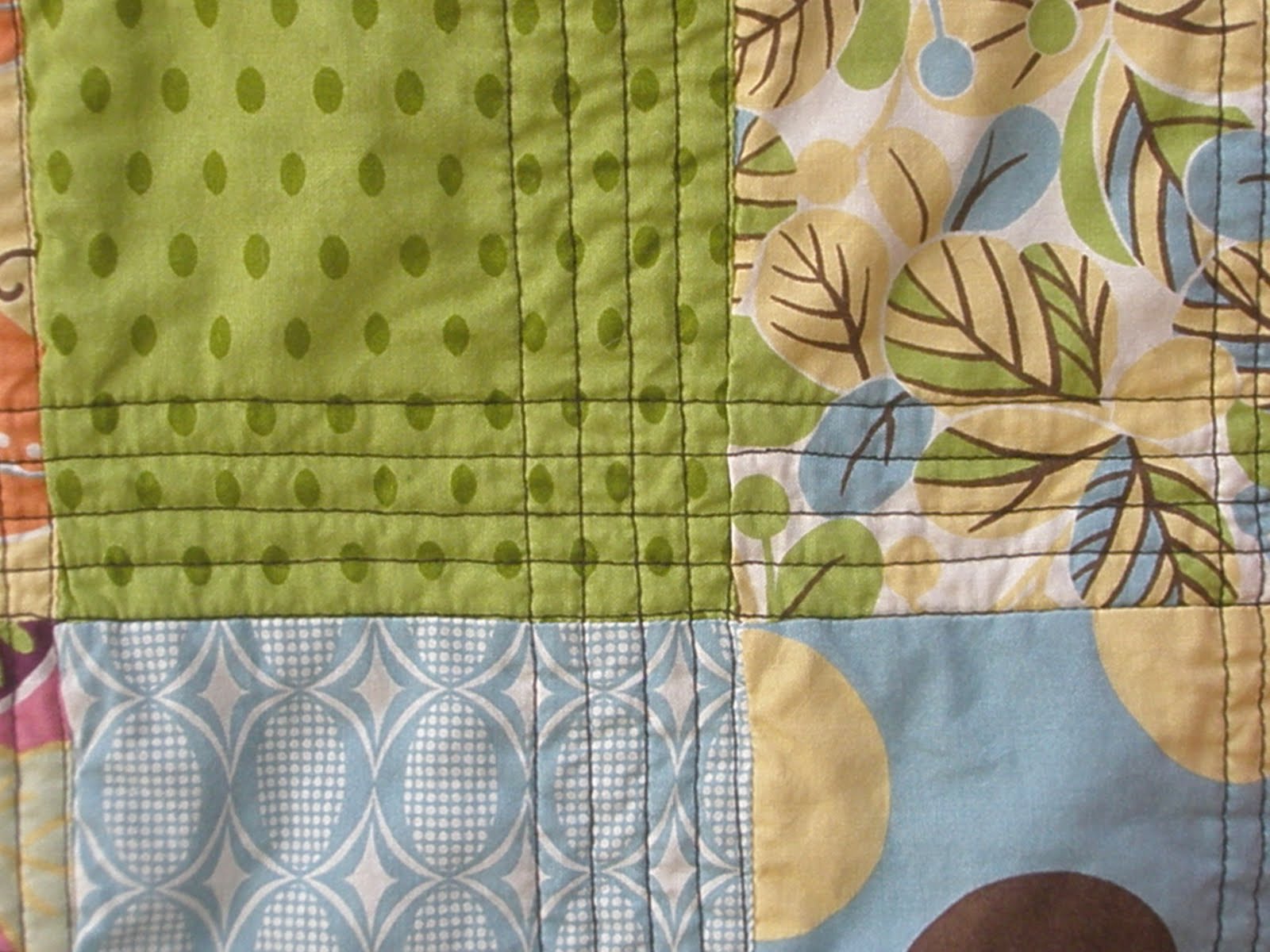
This is the best closeup I could get of her perfect, neat, even, straight stitches. As you can see from the grain of the fabric, these are pretty small stitches, but they're still beautifully formed. It didn't even take much messing with the tensions to get a perfect stitch--something I definitely can't say about my more modern machines, love them though I do.

I'm fairly confident I can get the top put together without any particular difficulty. I am a little less confident about the quilting part. I found that a bit tricky even with the aid of electricity. Still, other people manage to achieve stunning results quilting with treadle machines, so really...how hard could it be?

Yeah, I hear her laughing, too.

Thursday, June 17, 2010

FO: Man Blankie


I finished the Feel Better Blanket a couple of days ago.


This was my first machine quilting project, and one of my first machine sewing projects ever, so be gentle.

If you look closely, you will see that there are literally hundreds of errors in both piecing and quilting, and I am quite certain that the experienced quilters among you are shuddering with horror at the way I resolved some of the many issues I encountered in making this.


For all that, I loved working on this project! I love, love, love the fabrics, which I got in the form of Freebird Charm Packs from Moda Fabrics. I did absolutely nothing fancy, just sewed the individual squares together as they pleased me.


The border is plain red cotton. I used a twin sized cotton quilt batt which I cut to the custom size of this quilt, and the backing is chocolate colored flannel to make it extra cozy.


I discovered that I really enjoy the feel of just sewing straight lines with my lovely old machine, and that playing with beautiful fabrics is just as wonderful as playing with beautiful yarns.


For the quilting, I winged it, ending up with an ad hoc plaid pattern. As you can see, I used contrasting dark brown quilting thread. I did this to tone down the bright colors a touch, since the KH declared them, "almost a little too cheerful." I think it worked well; I like the way the brown stands out against the bright fabrics, even though it makes every little quilting error jump out at you--and there are a lot of quilting errors.


I tried several methods to get the quilting to go smoothly. In the end, I found that I preferred using the original old edging foot that came with my 1962 Pfaff 360. I didn't like the even feed foot I bought, or the straight stitch foot, or the darning foot. But the edging foot has a guide that helped get the lines straight and even, or at least less wobbly and uneven than the other feet, and was smoother and quieter than the even feed foot.


To finish it, I cut off the extra batting and the wrapped the backing forward over the edge batting and folded the red edging backward over the batting and the backing and sewed it down by hand. (For the record, I do know how to make and attach bias binding, but I chose not to in this case.) As you can see, I'm no better at hand sewing than machine sewing, but at least I could do this part sitting on the sofa in front of the tv. I finished it off with a good machine wash and dry to make it all soft and crinkly.

The KH has barely let his "man blankie" out of his sight for the past two days. He carries it from the sofa to his upstairs office to our bed, depending on where he's hanging out. I have resisted calling him "Linus" because that be mistaken for criticism, when it fact it tickles and flatters me that he seems to love this blanket so much!

Tuesday, June 8, 2010

Help!

Stop me before I sew again!


Or at least before I buy any more sewing machines.

It's just so hard to pass up an awesome deal on such a sweet little machine. I mean, seriously! $20? So this is my sweet Brother Galaxie 221--solid metal, built in cams for decorative stitches, and bright yellow!
And this case! Come on--it's yellow with turquoise flowers! Vintage perfect.

It looks like it's never been used. Clean as could be, inside and out.

I just love this. I don't know why it tickles my fancy so much. I think after sewing on the old machines with their complete lack of directions about anything, it's just funny how this manufacturer totally dummed-down the process.

These guides are everywhere. Probably a good thing, actually, since it didn't come with a manual and my online attempts to locate one --or any information at all about this machine--have utterly failed. I guess I'll be winging it with this machine...once I figure out where I'm going to put it. It is possible to have a sewing machine stash?

Monday, May 24, 2010

Oops, I Did It Again (again)


There's no justification for it. Really. I just love these old machines!

I picked this up this morning. It was posted on craigslist last night and I jumped on it. It's a Pfaff, like the last one I bought, only older and more basic. It only does straight stitch, zigzag, and reverse. I haven't been able to find out a whole lot about this model, except that it wasn't actually made by Pfaff. It was made by another German sewing machine company that Pfaff bought in 1957. Pfaff seems to have put its name on the remaining stock and sold them as the Pfaff 139. There don't seem to be a whole lot of them around.

This one belonged to the mother of the guy I bought it from, and he says she used it regularly up until a couple of years ago. It is spotlessly clean on the inside and the handwheel turns like butter, so I think that's probably true. It just needs a new motor belt, which is already on its way to me, and we'll be in business!

Just don't ask me why I need another sewing machine...'k?

Sunday, May 9, 2010

More Things I Learned Today


1. Do not use waxed hand-quilting thread for machine sewing. There is a reason the label specifies hand-quilting. This is not a scam to get you to buy more thread. That wax? Sewing machines don't like that wax

2. There are probably people who can get perfectly matched right-angle corners. I am not one of them. I know how crazy quilts came about.

3. A dog lying under the sewing table can run the sewing machine, but it's probably not a good idea.

4. Just because the needle looks okay doesn't mean it is.

5. An unidentified bent needle can drive a normally rational woman around the bend faster than a toddler with a permanent marker.

6. There is no reason to save old needles. None at all. Should you choose to save them "just in case" it is on no one's head but your own when you mistakenly put an old needle back in the machine. (See #5 above.)

7. Sewing is kind of the inverse of knitting: fast to do, sloooooooow to undo. There's no easy way to frog sewing.

8. Sewing faster will not straighten out that wonky seam.

9. Sewing a perfect seam doesn't count if the needle isn't threaded.

10. It is possible to "use up" a seam ripper.

11. The Knitting Goddess has a sister, and she is one nasty b*tch.

12. Perfection is overrated.

Thursday, April 8, 2010

Before and After, Part 2

In yesterday's post, I mentioned I've been cleaning up my old sewing machines, plural. In addition to Frances (my great-grandmother's machine), and Eliza (my new treadle), I also have a 1928 Singer 127 "Sphinx". Before picture:

This is the machine I've had the longest. It came out of an old house my parents bought when I was a little girl. I was quite taken with it, so my mom gave it to me. I was nine. I still remember writing a letter to the Singer company asking if they could please send me a manual for it. The hand written letter that began, "My name is Suzy _____ and I am nine years old" must have moved some nice person there, because they xeroxed an old manual and mailed it back to me. I don't know what happened to that xerox copy, but I was able to download a pdf of the original manual from the Singer website last week--for free. I love the digital age.

I knew this machine worked because I remember using it as a child, but I haven't used it in decades. The belt was broken, the cord to the motor was crumbling, and the chrome was tarnished. I'd never oiled the machine, greased the motor, or cleaned any of it.

Another before picture:

But I was able to find an original adjuster's manual online (also free--I do love the digital age) which helped me rehabilitate this old machine.

I loosened up all the working parts with WD-40, cleaned out all the old grease, and oiled the machine like crazy. I greased the motor, repaired the crumbling motor cord, and replaced the broken belt. Then I cleaned the exterior of the machine and polished all the chrome.

Here's the after:

I love the shiny scrollwork on the face plate.

You can just see the motor in this picture. It's not a Singer motor, which leads me to believe this may have originally been a treadle machine that was later converted to electricity. There is also an after-market lamp that I removed prior to cleaning--further evidence, I think, that this was converted.

If I had the space, I might turn this into a treadle machine. But then again, I might not. It runs beautifully. It's quieter and smoother than either of my other machines, although I still have a small issue with the stitches that I need to work out.

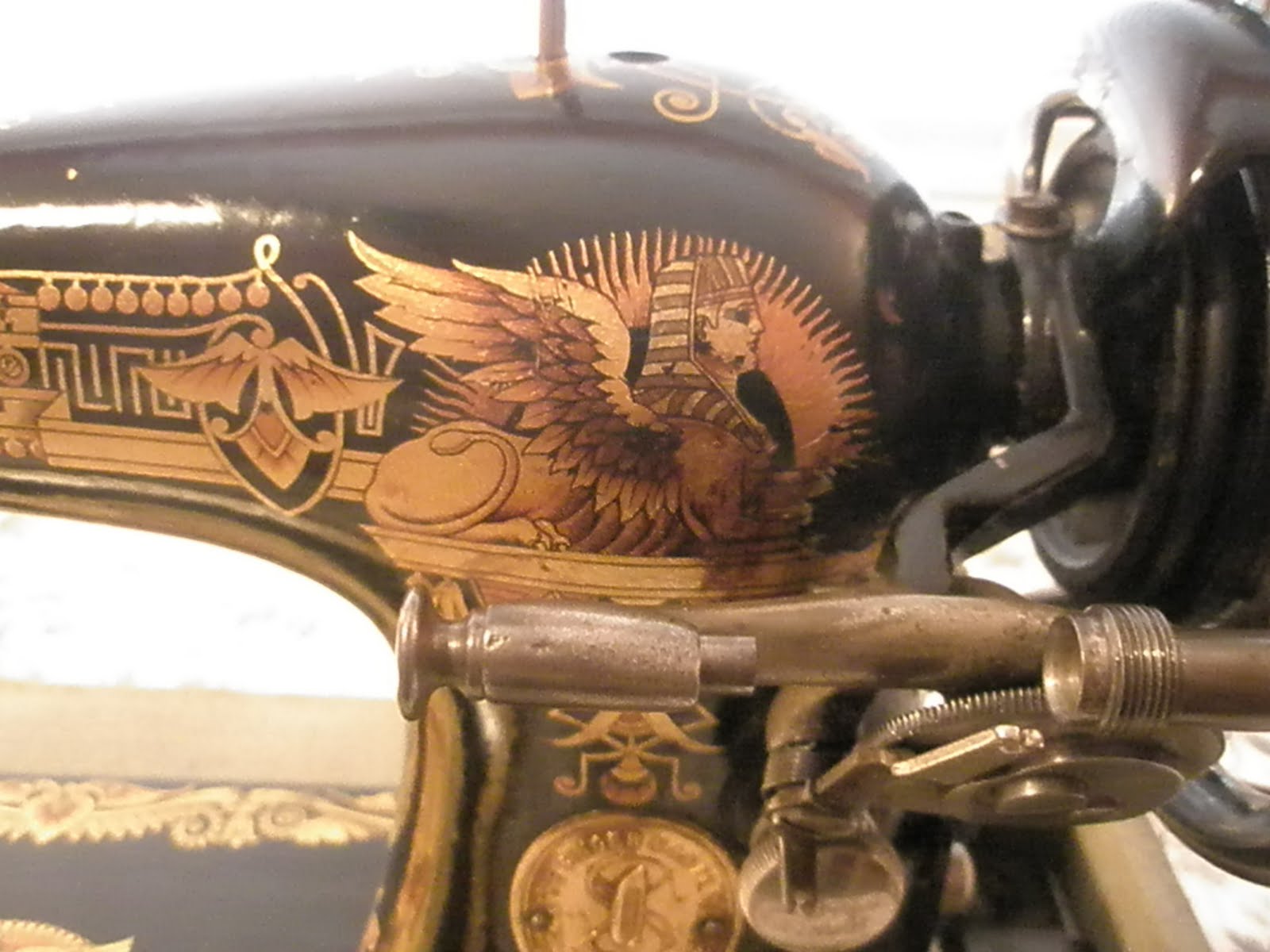
This is why it's called the "Sphinx":

I've named this one Victoria, after my mother, who gave her to me so many years ago.

I suspect, however, that I may not get to use her too much...

It appears someone else has laid claim to her.

And he's pretty good, too.

Monday, March 22, 2010

My New Baby

The trouble with a new hobby is the snowball effect.

In researching and seeking parts for Frances, I learned a lot more than I ever intended to about sewing machines. Among other things, I learned that parts for a Singer machine are cheap and easy to find almost everywhere, no matter how old the machine, whereas parts for Frances, whose maker, National Sewing Machines, went out of business more than half a century ago, are...not.

I also learned that many of the old machines could be purchased with either a hand crank, or a treadle, or an electric motor, depending on the consumer's preference. (Lots of people at the time still didn't have access to electricity. Some treadle and hand crank machines were even delivered with a boxed electric motor, to be converted once electrical lines made their way out to the consumer. Fascinating.)

And I learned that there are still lots of people today who use the old treadle or hand crank machines--or people-powered machines, as they are often called. This caught my interest in a big way. My primary objection to sewing machines has always been the noise and the speed and the whole industrial sort of nature of the things. But a treadle machine...hmmm. That's almost like a spinning wheel, isn't it?

On a lark, I took a little look on eBay to see what the things run. There are quite a few available, often for $200-$400--plus $150 in shipping. This is more than I'm willing to spend on a lark. But it just so happened (doesn't it always?) that there was an auction ending in 20 minutes for a lovely-looking treadle machine for pick up only, about an hour's drive from me.

You can see where this is going, I presume. Straight back to the title of the post. This is my new baby:

She is a Singer 66 "Redeye," manufactured in 1922. She is in surprisingly good shape for an 88-year-old.

You can see that her pretty decals are mostly intact. She has about half of the original attachments. She does need a new treadle belt, and her oak cabinet has a bit of water damage and some paint splatters:

She needs a bit of cleaning and oiling, but her mechanism seems to work properly. She uses modern bobbins and needles (yay!), and original and reproduction parts are widely available, meaning I don't have to worry about breaking or losing pieces as I do with Frances.

As you can see, she has already taken up residence in my new craft room. I am in the process of cleaning and repairing her and I can't wait to try her out! Oh, and the best part? She cost me exactly $81. Probably more than her original owner paid, but a smokin' deal, nonetheless!

Friday, March 19, 2010

FO: Second Skirt

I finished my second skirt. This one is also an embroidered linen blend (I'm sensing a theme here).

I made this using the same basic pattern as my first skirt, only using Frances instead of my mom's sewing machine. I am happy to report that Frances works like a dream.

I did learn something new about her, though. She doesn't have a zipper foot. It's not missing; it was never there to begin with. As a brand new sewer, I thought you could only sew in a zipper using a zipper foot. This is not strictly true. It is possible to sew in a zipper with a regular presser foot--at least it is if you're an experienced sewer. For me...well, it didn't go so smoothly. I had to rip out the zipper at least four times. I tried to use the advice some of you gave me about basting the seam together and then sewing in the zipper instead of making a lapped zipper, but the presser foot kept pushing the zipper to the side so the fabric wouldn't cover it. Finally I just gave up.

So this zipper is wonky, too, but in an entirely different way than the first one. Fortunately, I'm not all that picky about my attire; I figure no one will notice it anyway. (If I'm wrong, I don't want to know.)

If you look closely, you can see that I added a black bias binding to the hem. It adds a little weight and makes for a nice swinginess. It wasn't hard to do, but I mistakenly bought very narrow bias binding, which made it a little tricky to sew on. Next time I'll pick something wider. Live and learn, eh?

P.S. I'm still desperately seeking bobbins for Frances. Again, if anyone knows of a source for obscure bobbins, please let me know!